
In this post, I will teach you everything you need to know about how to sew stretch fabric successfully. Even if it is only your first time trying it!
Stretch fabrics allow us to make a great number of fantastic designs and garments. And even though it might seem like a challenging learning curve, I can promise you that you will be mastering all these techniques in no time!
You might even find that sewing stretchy fabric is less complicated than sewing with wovens.
Oh, and don’t worry. Because even if you don’t have a serger, I will show you how it is perfectly possible to sew stretch fabrics with a regular sewing machine.
So, grab yourself a cup of coffee and turn on that sewing machine as we learn a new sewing technique!

NOTE: This post contains affiliate links, which means that if you make a purchase using one of the links in this article, I may earn a commission at no extra cost to you (To know more about this, click here.)
Learning How to Sew Stretch Fabric is hard?
They showed me how to sew stretchy fabrics way over the end of all lessons in my design school.
Apparently, you had to be super advanced in your woven sewing techniques even to dare to make a single stitch on knit fabrics.
I found out that to be a big fat LIE.
Sewing with knits and stretchy fabrics is not at all scary when you practice for a bit!!
In fact, I have found another thing. It is way simpler to make clothes with knit fabrics than doing it with wovens. This is because knit garments will often skip a lot of complex design elements like darts, zippers, and buttholes.
Let me tell you. THAT is a big time-saver!
Now, I am going to divide this post into sections of the major things you need to know, learn, and apply to successfully sewing stretch fabrics and get AMAZING results.
Types of Stretch Fabrics

The most common type of stretch fabrics are knits. Knits are fabrics that are made with interloped yarns (in the form of chains). Resulting in an often ticker and stretchier material, making them ideal for fitted garments like sportswear or cozy ones like sweaters and pants.
There are many different Types of Knit Fabrics, and you can use each one of them in different sewing projects depending on their properties. For example, you can use a knit jersey to sew a t-shirt, whereas a swimming suit will be better made with Lycra spandex.
That being said, there are other types of stretchy fabrics that are not knits. Stretch wovens are made with a small percentage of elastane fabric. This gives them a little bit of stretch (even though they are still woven!). And finally, there are some fabrics that, when cut to the bias grainline, become really stretchy.
Getting familiarized with these fabrics early on your sewing journey will definitely make things easier! So make sure to read the different types of knit fabrics post so you can start understanding (and seeing) these fabrics.
Needles for Stretch Fabric

When you’re working with knit fabrics, it’s super important to choose the right needle to get that smooth and professional look you’re after. Don’t worry, I’m here to help you with that!

There are two different types of machine needles you should use when sewing stretchy fabrics: A ballpoint needle and a stretch needle. Let me explain each one.
1. Ballpoint needles

- Superior Control & Consistency: The SCHMETZ Jersey Ball Point needle features a rounded medium ball point design that glides between fabric fibers instead of piercing them, helping prevent snags, runs, and holes on delicate knits and stretch fabrics
- Skip-Free Stitches: Engineered for effortless sewing on jersey and some stretch fabric. This needle reduces skipped stitches, puckered seams, and uneven stitching
- Fabric-Friendly Performance: Ideal for cotton knitwear, bouclé, gauze, jersey, knit fabric, corsetry fabrics, sweatshirt fabric, tulle, and faux fur, the Jersey Needle protects delicate fibers while stitching for a flawless finish
A ballpoint needle is a type of sewing machine needle designed specifically for sewing knit and stretch fabrics. Knit fabrics tend to be pulled and twisted, and they even have skipped stitches when you sew them with a regular sewing needle. That is because regular needles are so sharp that they sometimes get stuck between the knit fibers, resulting in an ugly mess.
Ball point needles are designed with a rounded tip that will easily slide between the fibers of the fabrics instead of piercing them. By doing this, the fabric can retain its stretchability, and you can avoid getting skipped stitches.
2. Stretch needles

Even though stretch needles also have a rounded point (like ballpoint needles), the tip is slightly less rounded. That means they are not used for the same end goal. Stretch needles are the go-to choice for really stretchy fabrics like spandex, lycra, and elastics.
Stretch needles have a design that allows your machine to make a longer loop, which is great if your machine is skipping stitches.
So, if you are debating which needle you should use, just think about the material and stretch percentage of your fabric to make the better choice.
3. Twin Needle

- Package Includes – 3 x Twin Needles 2.0/ 90, 3.0/ 90, 4.0/ 90, the sizes are clearly marked on the blue area.
- Durable Material – These machine twin needles are made of stainless steel and plastic with good quality, they are durable and sturdy for a long life time.
- Unique Design – Each double-needle fitted with 2 needles can be easily threaded 2 same or different decorative lines to simultaneously stitch in a straight or pattern way,making it more beautiful.
Twin needles are a set of two parallel needles that make a parallel straight stitch and are commonly used on knit and stretch fabric to create a beautiful and clean hem.
I absolutely love to use twin needles when it comes to hemming my knit garments. They give you the final look on the front of a cover stitch machine, but you can make it with your regular sewing machine!
You can get these types of needles if you are sewing casual sewing garments like t-shirts, sweaters, pants, or sportswear.
And if you still don’t fully understand how this needle works. Don’t worry. I will explain myself better in the next sections.
Appropriate thread for stretch fabrics

Polyester thread is the best choice to sew with knit fabrics because it actually has a little bit of stretch, contrary to the 100% cotton threads.
This is important because when you are making knit garments, these usually don’t have any openings/closures (like zippers or buttons), so you can put them on. So, it is important to preserve as much of the stretch properties as you can.
Nylon thread is another great option for sewing stretchy fabrics. It is strong, has some stretch, and is resistant to abrasion. And just as polyester, nylon is a synthetic thread that works well with stretch materials.
Types of Stitches for Stretch Fabrics

Now comes the fun part! The stitches.
You can sew stretch fabrics (like 4 way stretch fabric) with both a Serger and a regular sewing machine. These are the types of stitches you will use depending on the machine of your choice.

Ok, so firstly, How do you sew stretch fabric with an overlocker?
Overlocker Stitch
An overlocker or serger machine is a sewing machine that makes an overclock stitch on one or more fabric layers to join them together and prevent them from fraying.
But thanks to their chain-shaped stitches, sergers are great for sewing knit fabrics and keeping their stretchability. You can learn more about what a Serger Machine does here.
Sergers have different types of stitches you can choose from depending on your fabric’s weight and purpose. The main stitch you will be using with stretchy fabrics is the 3 or 4-thread overlocker seam.
Most people think that sergers are the only machines that can be used to sew stretch fabrics, so the question arises. Can you sew stretchy fabric with a regular sewing machine?
The answer to this question is absolutely freakin’-yes! Sewing stretchy fabrics with a regular sewing machine is actually very easy. You just need to know what types of stitches to use.
Zigzag Stitch
On the one hand, you always have your trusty zigzag stitch. A zigzag forms a pattern on the shape of its name when the needle moves from one side to the other. It is excellent for sewing stretch fabrics because it allows the seam to stretch without breaking. The width and length of the zig-zag stitch can typically be adjusted on sewing machines, allowing you to customize it according to your project’s needs.
Stretch Stitch
A stretch stitch (also called a lighting stitch) is a type of sewing stitch on your sewing machine designed specifically for sewing stretch fabrics. This stitch forms the shape of a lightning bolt, which can end up looking very similar to a straight stitch. The difference is that it sews three straight stitches in quick succession before moving to the next set. This provides added strength and flexibility to the seam.
Machine Settings for Stretch Fabric
Presser Foot
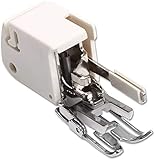
The perfect presser foot can actually vary depending on your sewing machine brand. From some sewing machines, the regular presser foot works very well on most stretchy fabrics, while other sewing machines (the most stubborn ones) might require you to change the foot.
For these last ones, the best you can do is get a walking foot.
If you’re working with stretchy or bulky fabrics, a walking foot can be a lifesaver!! It has an extra set of feed dogs that work in sync with your machine’s regular feed dogs, which makes the pressure on the fabric even on the top and the bottom. And what does that help me, you ask? Well, this simple action will keep your fabric from shifting or stretching while you sew.
So, even though they are more on the pricy side, a walking foot is definitely worth considering.
Tension adjustment

When sewing knits, it is usually best to use a standard tension setting of 4.0. This tension setting will work well for most knit fabrics, but it may not be suitable for heavier knits. If you are sewing a thicker knit fabric, you may need to lower the tension slightly to achieve the best results.
However, it is important to note that raising the tension is not recommended. This can cause the fabric to pucker or create unsightly seams.
Stitch length modification

Whenever you are working with any knit or stretchy fabrics, the longer the stitch length, the better. A longer stitch will help you to avoid wavy seams!
I typically use a longer stitch length of 3.0 minimum for sewing knits to prevent stretching. This has worked for most of my knits very well. But then, when I have thicker fabrics I raise the length up to 4.0-4.5. And both of these lengths work for either the zig zag or the stretch stitch.
Remember to test these settings on a scrap of fabric so you can modify them as you see fit.
PRO TIP: How do you sew stretchy fabric without puckering?

The biggest struggle of anyone who is sewing with stretchy fabrics is getting puckers while they are sewing. That is why one of my favorite sewing stretch fabrics tips is the hack I have used for years to sew stretchy fabric without puckering, which is FAILPROOF!
And it is way easier than you think. The simple answer to your problems is: Patternmaking paper.
As you read and breathe, my precious. Using a scrap of patternmaking (or tissue) paper over your fabric will prevent your seams from getting puckered, twisted, and stuck between the feeding dogs. Oh! And forget about getting skipped stitches, too!
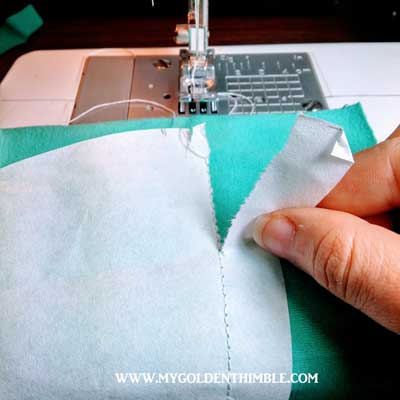
In my post on how to sew stretch fabric without puckering, I go into detail about this hack, and I even have a video showing you the huge difference this hack can make for your knit sewing projects.
While every single tip I have shared so far is full of valuable knowledge, this hack can be a real-life savior for when nothing else is working, or… let’s be honest, when you just don’t feel like thinking all that hard just to sew a pretty stretchy fabric.
Additional Tips for Sewing Stretchy Fabrics.
- Use Stretch Stitches:
Take advantage of stretch stitches on your sewing machine, such as lightning stitches, triple zig-zag, or other specialty stretch stitches. These stitches are designed to accommodate the stretch in knit fabrics.
- Test Stitch on Scrap Fabric:
Before starting your actual project, always test your machine settings and stitches on a scrap piece of the same fabric. This allows you to fine-tune your settings and ensures that your chosen stitch works well with the specific stretchiness of the material.
- Stabilize Seams with Stay Tape or Clear Elastic:
To prevent seams from stretching out of shape, consider stabilizing them with stay tape or clear elastic. Baste the stabilizer along the seam allowance before sewing the actual seam. This is especially useful in areas like shoulder seams and necklines.
- Use a Twin Needle for Hems:
Achieve professional-looking hems on knit garments by using a twin needle. This creates parallel lines of stitching on the top with a zig-zag pattern on the back, allowing the hem to stretch without popping stitches.
- Reduce Pressure on the Presser Foot:
Some sewing machines allow you to adjust the pressure applied by the presser foot. Reduce the pressure when working with stretch fabrics to minimize distortion and stretching as the fabric is fed through the machine.
- Grading Seams for Reduced Bulk:
Reduce bulk in seams by grading them. Trim one seam allowance slightly narrower than the other and press the seams open. This technique is especially useful in areas where multiple layers of fabric come together, like at the underarm or crotch.
- Practice Controlled Sewing Speed:
Maintain a controlled sewing speed, especially when sewing curves or intricate areas. This allows you to guide the fabric smoothly through the machine, preventing stretching or distortion.
Conclusion
And that was it for this lesson, my amazing and smart friend. Now that you know how to sew stretch fabric, tell me, Which is the first project you are going to make??
Also, do you know any other good tips or tricks that have helped you sew on stretch fabrics?? I would love to know and maybe include them in this post! Let me know in the comment box below!
Remember to save this post on Pinterest and share it on your social media to help me get to more sewing fans like you and me and share this knowledge!



Would like to know more. very interesting article. Thank you for sharing. I tried to repair a swim top, what a mess I made of it, the elastic was rotted in it, needless, to say I was not successful.
Oh, I hate to mess with old swimsuit elastics, they are very hard to repair. I actually use normal braided elastic in all my swimsuits, just because of that.
Thank for the tips on sewing knit fabric. This is very helpful and I will definitely try them. My next project is an up cycle idea. I am going to take some tank tops and cut the top part off add elastic and use as layering with other tops.
You are welcome!!
Oh that sounds amazing! For adding elastic to knit fabrics I definitely recommend you use the zigzag stitch, that one will allow more stretch than the “stretch stitch”. (I know, ironic haha)
I would love to see your tops if you want to share them with us at My Golden Thimble Sewing Club on facebook.