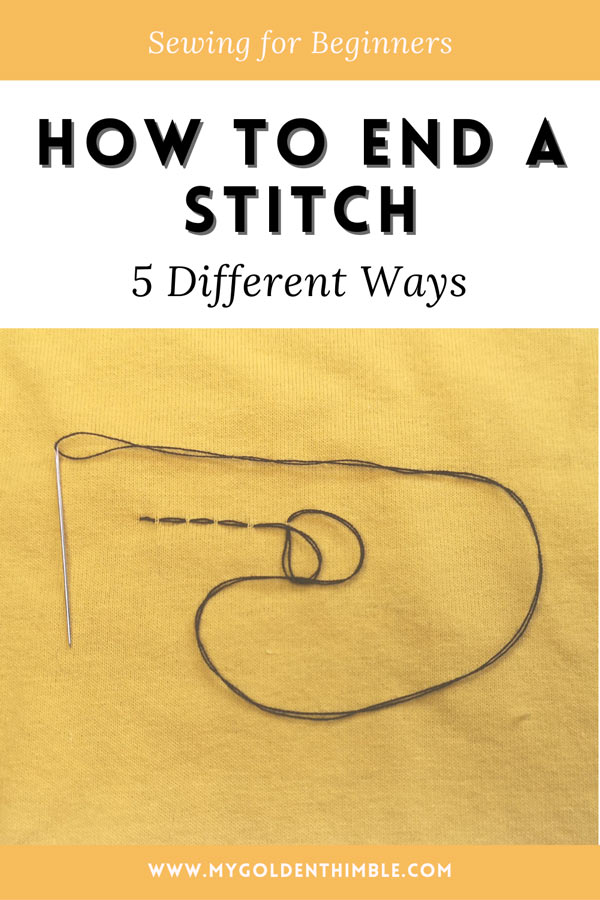
Knowing How to End a Stitch is one of the most essential things you need to know if you want to learn to sew.
It doesn’t matter if you want to sew only to make quick garment repairs and small projects or make a serious hobby.
If a stitch is not properly secured at the end, your seams will open at the least convenient time!
Believe me; you don’t want that to happen to you.That’s why today I will show you five different ways to finish a stitch so it won’t open unless a seam ripper does it.
NOTE: This post contains affiliate links, which means that if you make a purchase using one of the links in this article, I may earn a commission at no extra cost to you (To know more about this, click here.)
We have done a lot of beautiful and valuable sewing projects on this blog. Many of them use a sewing machine, and a few others by sewing them only by hand.
Even if you have a beginner sewing machine, you have to learn some basic skills that you will need with any type of machine.
Things such as how to thread your machine correctly or how to wind a bobbin the right way.
These are some of the first skills we learn. Most of them are instructions that we can easily get online or in our instruction manuals.
Table of Contents:
- Hand Sewing Importance.
- How do you lock a stitch at the end?
- How many knots should I make at the end of a stitch?
- What’s the Best Needle to sew by Hand? (Needle Sizes)
- How to end a Stitch by Hand? 5 Ways
- How to End a Stitch by Sewing Machine?
Why is hand Sewing important?
Sewing with a machine definitely makes our lives easier. But that doesn’t mean that we can skip hand sewing just because we have a machine.
Even if you want to sew mostly with a sewing machine, you still need to know how to sew by hand.
There are a lot of times we need this skill. Like when you need to make an invisible stitch to close open seams.
So, knowing how to end a stitch properly is an indispensable technique.
And that’s for anyone with and without a sewing machine who wants to make small or large projects.
Or even just to be ready for a wardrobe emergency on any occasion.
How do you lock a stitch at the end?
There are two basic ways to secure a seam when you are done sewing. The first one is doing it by hand, and the second one is doing it with a backstitch with a sewing machine.
You will find a couple of different options for each of these global ways.
By Hand.
The basic idea to end a stitch by hand is that you have to insert your needle over the last stitch you made, make a loop and insert the needle through that loop pulling the thread to make a knot.
But that’s not the only way.
We have several options to close the stitch that we are making. In this post, we will show you 5.
By a Sewing Machine.
Ending a stitch with a sewing machine is way easier and faster.
The only thing you have to do is push the reverse lever or button, which is usually at the front of your machine.
This will make the feed dogs (here is a post of the parts of a sewing machine, in case you don’t know what feed dogs are) go in reverse so you can stitch backward over the same seam.
Make only between 3 to 5 backstitches and then go forward again.
Cut the thread after you are done.
How many knots should I make when I finish a Stitch?
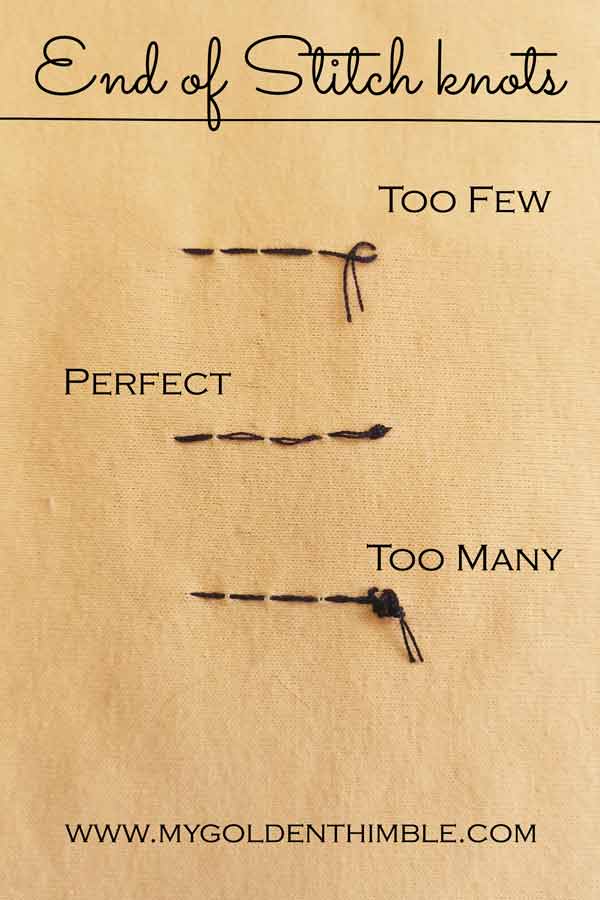
Don’t ever make just one knot at the end of a stitch by hand. Our recommendation is to sew between 2 to 3 tiny tight knots.
Less than that will inevitably open your seams. More will create an ugly bulk, which will not look ascetically.
As much as possible, try to make the finishing knots on the wrong side of the fabrics of your projects or between the seams.
What is the best needle to sew by hand?
The best needle for your project will depend on the fabric weight of what you are sewing.
Keep in mind that there are many different types of hand needles. Tapestry, quilting, and sharp needles are just a few.
And every type of hand needle has different sizes.

- General Sewing Hand Needles: Use sizes 3,4,5, and 6 to sew medium-weight fabrics such as the ones you find on cotton shirts or dresses. These needles are ideal for mending clothes as they are easy to thread and handle.
- Medium to Heavy Sewing Hand Needles: The needle sizes 1 to 3 are perfect for every fabric from medium to heavyweights, such as pants, denim, and outdoor fabric (such as the one on cushions). They are thicker and longer than the general size needles, making them extremely easy to handle and thread. You can also pierce easily more heavyweight fabrics.
- Delicate Sewing Hand Needles: If you need to sew or mend anything with a sheer fabric such as chiffon or linen, you want to use 10, 11, and 12 size needles. These are shorter, sharper, and way thinner than the latter two, so they will pass easily through the fabrics without making a big hole or damaging it.
How to End a Stitch by Hand. 5 Different Ways
Method 1. Simple Knot with the needle.

1. Sew the Before-to-the-Last Stitch.
Sew every stitch evenly until there is only one missing to reach the seam allowance mark.
Make sure you have at least 5” or 6” of remaining thread, as you will need it to make the knot.
2. Make a loop.
Make the final stitch but don’t pull the thread all the way.
Leave a small loop with the last stitch.
3. Insert the Needle through the Loop.
Insert the needle near the end of the last stitch to bring it forward.
Then pass the needle through the loop we made in step #2.
Pull the needle and thread all the way softly.
4. Repeat step #3.
We will pass our needle through the last stitch to make a double knot one more time.
Don’t pull all the way to form a second loop.
Pass the needle through the new loop and pull up all the way until the knot is formed.
Use your fingers or fingernails to keep the first knot from moving or opening.
5. Cut the leftover thread
Once the knots have been made, cut off the excess thread for a cleaner finish.
Method 2. Reinforce the last stitch.
Use this technique when you want to make sure you make a strong knot.

1. Sew the Before-to-the-Last Stitch.
Sew every stitch evenly until there is only one missing to reach the seam allowance mark.
Make sure you have at least 5” or 6” of remaining thread, as you will need it to make the knot.
2. Make the last stitch.
Insert the needle from the back forward at the distance where the last stitch should end.
Pull the thread to form the last stitch.
3. Repeat the last stitch.
Repeat step #2 one more time, but don’t pull all the way this time so a loop can form.
4. Insert the Needle through the Loop.
Then pass the needle through the loop we made in step #3.
Pull the needle and thread all the way softly.
Repeat this step one more time to make a double knot.
5. Cut the excess thread
Once the knots have been made, make sure that the knot is very tight and cut off the excess thread for a cleaner finish.
Method 3. Knot by Hand.
This is one of the stronger and cleaner ways to end a stitch.
It is slower than the other techniques.
But making a double knot like this will secure your seams better because the 2 knots are made with “single” threads instead of double threads.
This will make the knot tighter and smaller.

1. Make the last stitch.
Make the last stitch of your seam.
Leave 6” to 7” of remaining thread, as this will be needed for the knot.
2. Remove the needle.
Cut the threads near the needle to remove it, or measure the 6”-7” and cut the threads there.
3. Tie the Knot.
Separate the ends of the threads. Cross them and take the thread of the bottom through the loop.
Pull both threads in opposite directions.
Remember not to pull too hard, or you could damage or make wrinkles to the fabric.
4. Make another Knot.
Repeat step #3 to make a double knot.
5. Cut the excess thread
Once the knots have been made, cut off the excess thread for a cleaner finish.
Method 4. Backstitch Reinforcement
This technique for ending a stitch is ideal for heavyweight fabrics like denim or canvas.
It is perfect for securing the end of the seams to endure rough treatment such as the ones these type of fabrics has.

1. Sew the Before-to-the-Last Stitch.
Sew every stitch evenly until there is only one missing to reach the seam allowance mark.
Make sure you have at least 5” or 6” of remaining thread, as this will be needed to make the knot.
2. Make a hand backstitch.
Take the needle and insert it back into the middle of the previous stitch.
Insert the needle forward through the place where the last stitch should end.
Pull softly to form a loop.
3. Make a knot
Pass the needle through the loop from the previous step.
Pull gently until the loop is closed.
4. Secure the knot.
Repeat step #3 to secure the knot. Start from the same points to avoid creating bumps.
5. Cut the excess thread
Once the knots have been made, cut off the excess thread for a cleaner finish.
Method 5. Simple double-knot
No complications. This technique is straightforward and quick.
Ideal for easy and simple projects with mediumweight fabrics such as placemats or coasters.
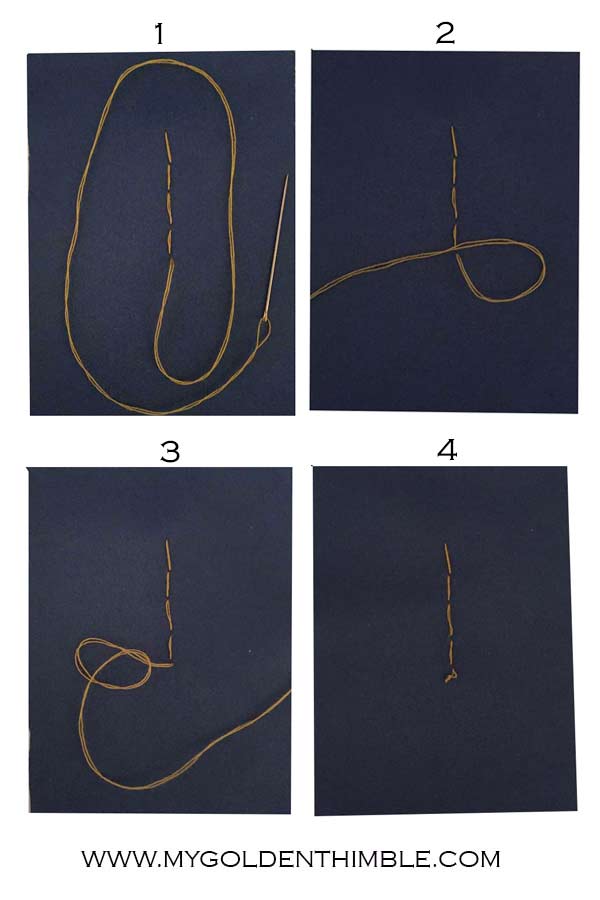
1. Make the last stitch.
Make the last stitch of your seam.
Leave a few inches of thread, which will be needed for the knot.
2. Make a circle.
Make a circle with the thread, big enough to put your finger in.
3. Close the circle.
Hold the end of the circle thread with your finger.
Pass the needle through the back to the front of the circle.
Pull up the thread as you hold the circle to form a knot.
Use your fingers to keep the knot as close as possible to the fabric.
Repeat to make a double knot.
4. Cut the excess thread.
Once the knots have been made, cut off the excess thread for a cleaner finish.
How to end a stitch by Sewing Machine.
The other way to finish a Stitch is by using the backstitch feature on Your Sewing Machine.

- Make all your sewing. Stop when you reach the end of the seam.
- Push the backstitch lever or button (if it is a button, it will have a “U” shaped arrow) and sew 3-4 stitches back. Stop.
- Sew forward again.
- Cut off the remaining threads.
And that’s it! Now you know How to end a Stitch in many different ways depending on your needs.
I recommend you practice as much as you can with a scrap of fabric to get better at making tiny knots.
Remember that the smaller and tighter, the less bulk will make on the right sides of the fabrics. It might be a small detail for others, but you will develop an eye with time to those details.
Do you know an easier way to end a stitch? Let me know in the comments!
Don’t forget to follow us on Social Media!!