With this complete Button Sizes Guide, you will learn to measure your buttons accurately and effortlessly.
Now it will be easy for you to buy the perfect button size online, replace them, and even get them from a catalog without making any sizing mistakes.
In this post, I will show you everything you need to know about measuring buttons with the correct measuring unit: the Ligne.
I will also provide you with a super cute and free printable button size chart you can use at home and have in hand at any given moment if you need to measure any size of a button.
So keep reading and find out everything about the most popular fastening of them all.
NOTE: This post contains affiliate links, which means that if you make a purchase using one of the links in this article, I may earn a commission at no extra cost to you (To know more about this, click here.)
Why do we even bother Measuring Buttons?
Knowing how to sew a button is not the only thing you need to know about this fastening. Buttons have been a popular fastening item for clothing for thousands of years.
So it’s no wonder that nowadays there is a considerable amount of different types of buttons, from materials to shapes and, of course, sizes.
And if you ever wondered how to find out the size of a button? Then you are in the right place, my friend.
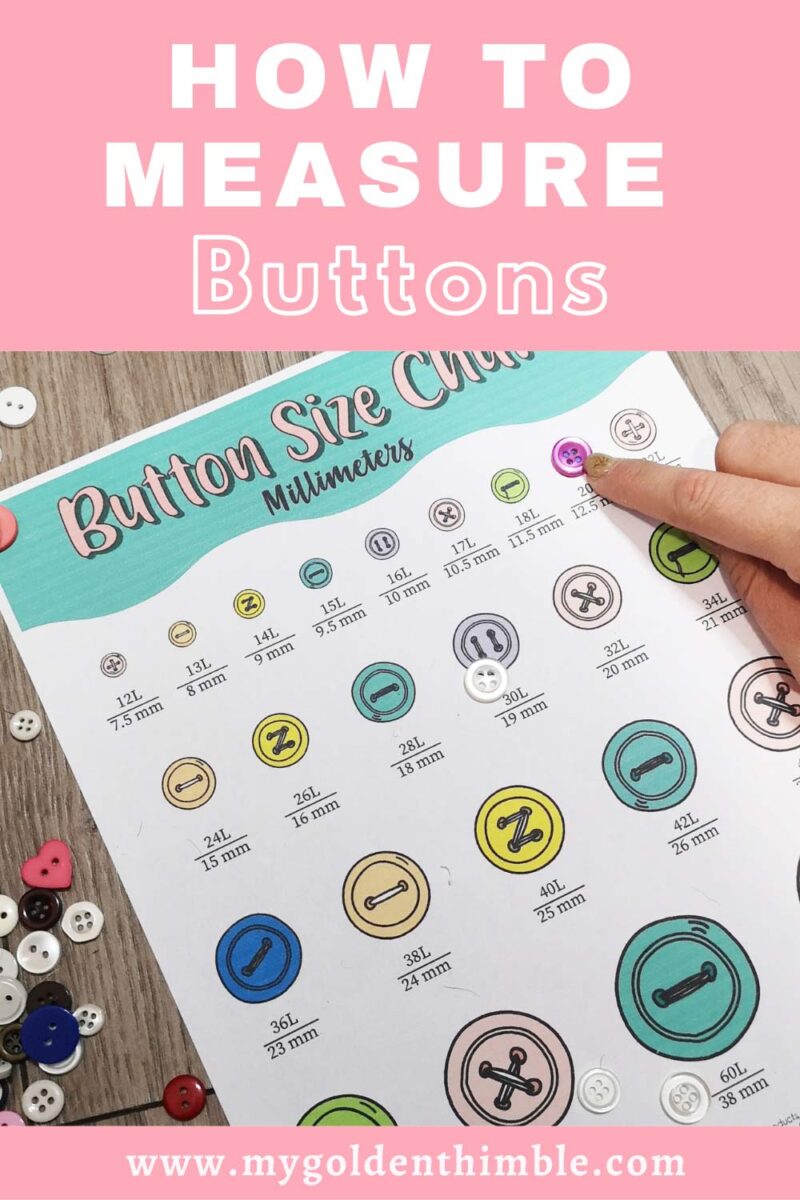
There are several methods available to measure buttons physically. One is a gauge ruler, and another is a chart like the one I will give you later in this post.
The best way to measure a button is by using a printable size chart as a reference. This is way more accurate than using rulers.

And as button makers use millimetric PERFECT measurements, using a flawed ruler will be useless to get an accurate measurement.
The difference between one size button and another can be up to 1mm ( 0.039 in). So, now you may understand why I don’t recommend using rulers for measuring your buttons.
But let’s see what you CAN do to determine the size of your buttons.
What is the button Unit for buttons?

Buttons are measured with a unit called Ligne, which measures 2.2558291 mm (0.8881216 in).
The word “ligne” comes from the word “line” in French.
A ligne is a unit historically used to measure the length that people used in France before they adopted the metric system.
Lignes are also used in watchmaking, hatmaking, and buttonmaking.
Button Sizes Chart.
Now that you know that buttons measure in lines, which is the diameter of the button in either millimeters or inches, you might have other questions.
For example, let’s say you already know the diameter in millimeters of your button. But now you need to know how big a 20 mm button is.
Well, that’s why I made this quick reference online chart, too, so you can use it to convert the size of your buttons from millimeters or inches to lignes.
In this example, a 20 mm button is equivalent to 32L (32 lignes) by consulting the chart.
Use this chart to convert the sizes of your buttons quickly.
| Lignes | Millimeters (mm) | Inches (in) |
|---|---|---|
| 12L | 7.5mm | 5/16″ |
| 13L | 8mm | 5/16″ |
| 14L | 9mm | 11/32″ |
| 15L | 9.5mm | 3/8″ |
| 16L | 10mm | 13/32″ |
| 17L | 10.5mm | 7/16″ |
| 18L | 11.5mm | 15/32″ |
| 20L | 12.5mm | 1/2″ |
| 22L | 14mm | 9/16″ |
| 24L | 15mm | 5/8″ |
| 26L | 16mm | 21/32″ |
| 28L | 18mm | 23/32″ |
| 30L | 19mm | 3/4″ |
| 32L | 20mm | 13/16″ |
| 34L | 21mm | 27/32″ |
| 36L | 23mm | 7/8″ |
| 38L | 24mm | 15/16″ |
| 40L | 25mm | 1″ |
| 42L | 26mm | 1 1/32″ |
| 44L | 28mm | 1 7/64″ |
| 48L | 30mm | 1 3/16″ |
| 54L | 34mm | 1 3/8″ |
| 60L | 38mm | 1 1/2″ |
| 64L | 40mm | 1 3/4″ |
Our Button Size Chart:
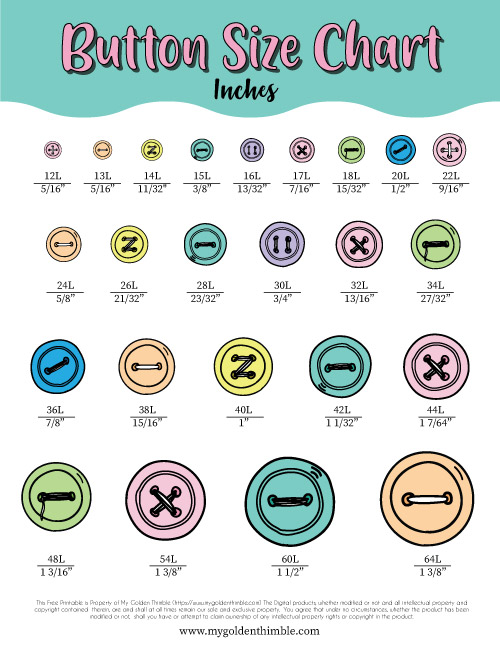
You can determine any button size by printing our button size chart.
To determine any button size, print a button size chart and place your button over the circumference to know its measurement in lines. I created this handy chart to easily find round button sizes.
It’s completely free to download, and it comes in two measurements for your convenience: Millimeters and Inches.

How to use the printable button size chart?
1. Download.
Scroll down to this post to get the product link for this printable, which you can get completely free from our printable shop.
Follow the instructions and download the PDF file with the two charts (millimeters and inches).
2. Print in real size.
You can print this chart at home with any printer.
Make sure you print at 100% scale or “real size”.
Do not use the settings “Fit to Page” or any other one that might distort the shape and sizes of the button drawings.
3. Match your buttons with the chart buttons.
Place your buttons over the drawings of the closest resembling button drawing in size.
Slide through the similar buttons and make sure there is an EXACT match through the diameter of the black outer lines.
There are some buttons with only a 1 mm size difference, so make sure there is absolutely no color showing on any side, like in this picture.

I like to use the black line as my guide and place my button right over it on one side. If any color shows on the side, I will change it to a smaller circle.
I know that the drawings have a “freestyle” and that there are no perfect circles. That’s ok. I made sure that the diameters measured exactly what they needed to on each one of the drawings.
So, as long as you follow the directions above, you can measure your buttons accurately with this chart.
What size button do I need for my project?
Even though, as I said before, there is no written rule specifying the size of button to use for each garment.
But some standard measurements are used in the world of clothing for each garment. They go as follows.
- Shirts: 16L to 20L
- Shirt’s Cuffs: 15L
- Shirt’s Collar: 13L
- Blouses: 16L
- Skirts: 22L
- Trousers: 24L
- Jeans: 28L
- Jackets: 32L
- Coats: 48L
What size should I make my buttonholes?
The rule of thumb is to make your buttonholes 3mm longer than the diameter of the button.
This is great information if you like to make buttonholes by hand. I think these look a lot better than the ones made by a machine. But they do take a good amount of time to make.
On the other hand, if you use a sewing machine to make buttonholes, the buttonhole presser foot will determine the size of your buttonhole.
As well as the types of buttons, there are also different types of buttonholes used in garments.
They will vary depending on the type of garment. And they are not only shaped for decorative purposes but also practical, like in the way of a key buttonhole.
Psst…Is this article helpful to you?? Please support us so we can keep making awesome tutorials for you by buying us a cup of coffee here. We will be forever grateful!
Don’t forget to follow us on Social Media!!



Love the button measuring charts!!! I am always struggling with a ruler to hold the button straight, especially if it is a small sized button. It is hard to see around my fingers. I have even resorted to drawing around a button and them measuring the drawing. Thank you!
Wow! Drawing around a button is a very smart hack!
All though I am happy you have a better way to measure your buttons now 😀